
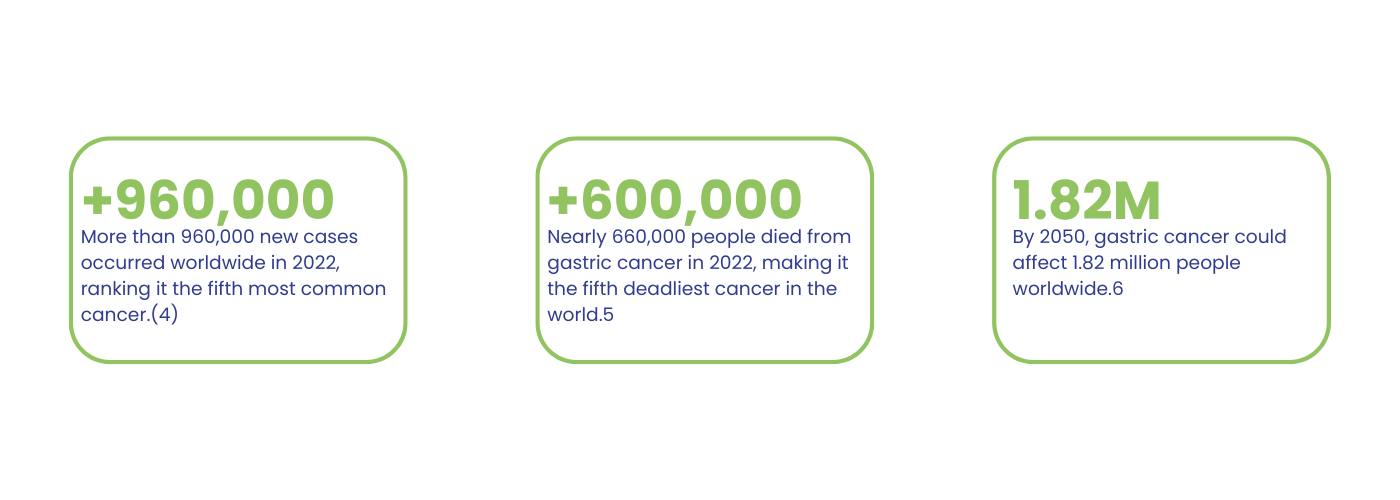
Gastric cancer is linked to a number of environmental and behavioral risk factors. Due to its general, nonspecific symptoms, diagnosis of this type of cancer often occurs too late, compromising the prognosis.
More commonly known as stomach cancer, gastric cancer is more prevalent in developing countries than in industrialized ones. The countries most impacted by the disease are in Asia (including China), South America (mainly Chile, Peru, and Colombia), and Eastern Europe. An exception for industrialized countries is Japan1, which has a particularly high incidence of the disease. Sub-Saharan Africa, on the other hand, is relatively unaffected, with a lower incidence than Europe.
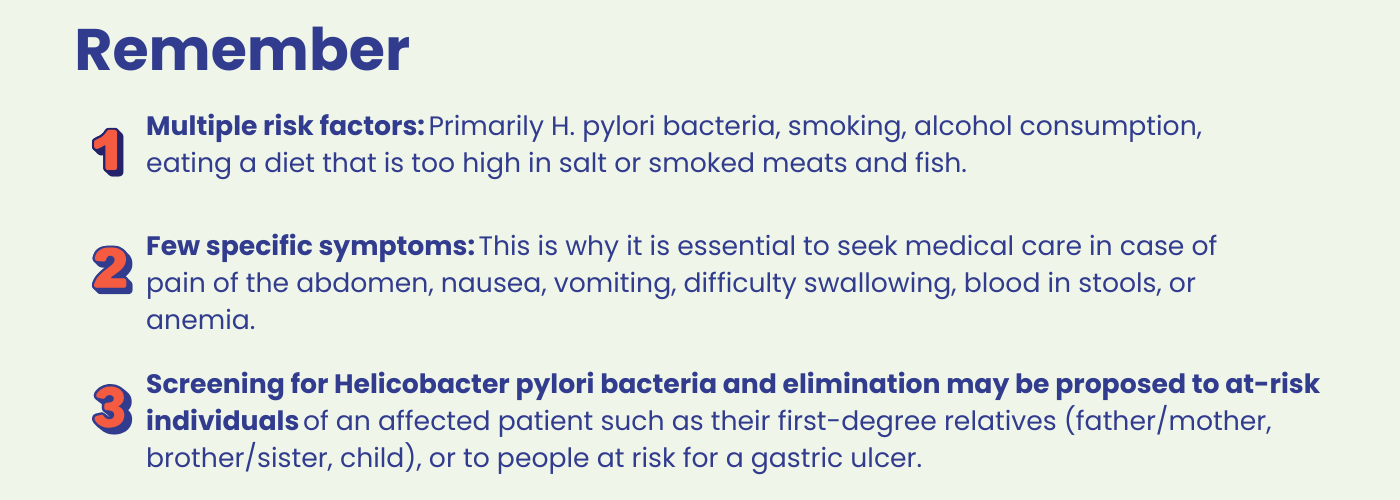
This distribution can be explained by the nature of the risk factors. The main risk factor is the presence of Helicobacter pylori (H. pylori) bacteria in the stomach; it is responsible for 80% of gastric cancers.2 This strain of bacteria is generally contracted in childhood and is the cause of chronic gastritis, an inflammation of the stomach lining that develops into cancer in 1% of people infected.3 The prevalence of H. pylori infection is diminishing, however, as a result of better hygiene practices, improved food preservation methods, and access to drinking water and antibiotics.
Other risk factors identified include smoking, alcohol, inadequate fruit and vegetable intake, and a diet high in salt or too much smoked meat and fish. In fact, high consumption of smoked products is believed to be the reason for the elevated incidence in Japan. Family history or genetic predisposition may also be associated with the disease. Like other cancers, the chances of survival increase with early diagnosis. More commonly known as stomach cancer, gastric cancer is more prevalent in developing countries than in industrialized ones. The countries most impacted by the disease are in Asia (including China), South America (mainly Chile, Peru, and Colombia), and Eastern Europe.
The stomach: The main digestive organ
The stomach performs two functions in the body.
- The first is chemical: It produces a combination of acids and enzymes, called ‘gastric juices,’ which are essentially a mixture of hydrochloric acid and digestive enzymes, in particular pepsin, which breaks down proteins.
- The second function is mechanical. When the stomach muscles contract, they knead the stomach’s contents, transforming them into a semi-fluid mass (chyme), which is then transported to the intestine.
Most stomach cancers (over 90%) are adenocarcinomas7 that occur in the stomach lining, the innermost layer where the acid- and enzyme-producing glands are located.
Cancer can affect the entire stomach. When it occurs in the upper two-thirds of the stomach (near the esophagus), the tumors are referred to as proximal. When it is in the lower third of the stomach, near the intestine, the tumors are called distal.
Early cancer detection
Gastrectomy, a major surgical procedure
Gastrectomy is a surgery which involves ablation of the stomach. It can be performed when:
- the cancer is diagnosed in the early stages (only the mucous lining is affected).
- it is localized (restricted to the stomach), or when locally advanced (spread to adjacent organs, nearby lymph nodes).
- the tumor has metastasized to other organs (liver, lungs, ovaries), in which case an operation is proposed in order to reduce the size of the tumor.
Depending on the stage of the disease, the surgeon will remove all or part of the stomach (total or partial gastrectomy). The operation also involves restoring the continuity of the digestive tract when possible. Otherwise, it is necessary to perform a gastrostomy, which involves connecting an artificial feeding apparatus for nutritional support.
Chemotherapy to maximize the chances of survival
Chemotherapy, which is sometimes combined with radiotherapy, can be administered prior to the operation (neoadjuvant) in order to reduce the size of the tumor so that it can be more easily removed. Preoperative chemotherapy treatment lasts between two and three months. Postoperative chemotherapy, on the other hand, is administered for a duration of two to four months. Its purpose is to reduce the risk of recurrence for high-risk patients by eliminating residual cancer cells. In the presence of metastases (secondary tumors), palliative chemotherapy slows the progression of the disease and relieves symptoms linked to the tumor, improving quality of life.
References:
[1]– Globocan 2022, Centre international de recherche sur le cancer – OMS https://gco.iarc.fr/today/data/factsheets/cancers/7-Stomach-fact-sheet.pdf
[2 ]– Institut national du cancer, octobre 2024https://www.e-cancer.fr/Patients-et-proches/Les-cancers/Cancer-de-l-estomac/Facteurs-de-risques
[3 ]– Centre de lutte contre le cancer, octobre 2024 / https://www.cancer-environnement.fr/417-Cancer-de-lestomac.ce.aspx
[4 ]– WHO, International Agency for Research on Cancer, October 2024 / Cancer Today / Absolute numbers, Mortality, Both sexes, in 2022
[5 ]– WHO, International Agency for Research on Cancer, October 2024 / Cancer Today (iarc.fr)/ Absolute numbers Mortality, Both sexes, in 2022
[6 ]– WHO, International Agency for Research on Cancer, October 2024 / Cancer Tomorrow (iarc.fr)/ Estimated number of new cases from 2022 to indefined, Males and Females, age 0-85+
[7 ]– ALD n°30 – Guide médecin sur le cancer de l’estomac, HAS, décembre 2012/ https://www.has-sante.fr/jcms/c_1105137/fr/ald-n-30-cancer-de-l-estomac
NRD25-INST-ADV-007 11/2025